Thursday, 12 March 2015

Social Object: First prototype

First prototype, I have found several tutorial on Youtube on how to make EMF Detector at home with arduino, which i am very excited to test it out myself, so I follow the instruction, which is as simple as one LED, one 3.3 megaohm resistor and a jump wires.


The jump wire acts like a prop in this setup to receive ambient energy(EMF) into analog pin, the 3.3 megaohm resistor is a pull-down resistor, to prevent the input from floating. If the input is floating, it won't have a potential, and the readings will be inaccurate due to the input erratically causing the LED's to blink. By adding the pull-down resistor, an electric potential is set as well as a stable "low" for the pin. 3.3megaohms appears to be a effective resistance for filtering out noise from actual EMF.


As i built mine prototype from the instruction of the video, I didnt really believe it would be that easy, it turned out I was right, Although this design is able to detect much AC current EMF, in terms of DC current electronics did not work as well as, I am struggling with this problem, I suspect that the prop isn't long enough hence the arduino cannot find any DC current, but not until I tested my theory I will know if I am correct or not at this point.


Friday, 6 March 2015

Hauntology

Today we have a very interesting workshop about Hauntology. Basically what it's saying its that for whatever technology, if we cannot reverse engineering the components and have full understanding of how it works, it can be considered as magic.

"Any sufficiently advanced technology is indistinguishable from magic"
                                                                                    -Arthur C. Clarke 
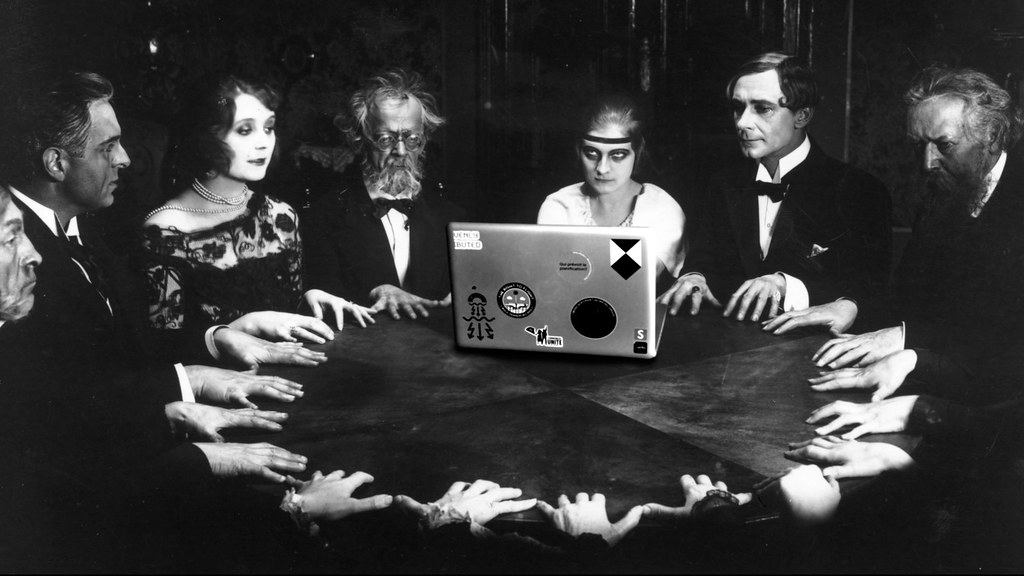
                       

Seance with my laptop.

As technology is so far advanced today and super efficient, almost none has the abilities to tell each every technology's working principles. So this is not about a classic ghost story, its about understanding a technology and been able to understand what does it actually relying on to make it work. 

Today, when we are introduced to a new product, we know its functionality and we know how it's supposed to be used, we naturally accepted and convinced the true that we do no need to know its working principle to operate it. which could lead to some consequences we could not foreseen. i.e a prank done by the internet claiming that iOS update will waterproof the iphone. 

Waterproofing firmware hoax

Which may seen stupid prank that none would ever fall into yet we are wrong, there are a lot more people actually believe in the claim and ultimately broke their phone due to lack of understanding the differences between software and hardware. As Clarke would suggest, they did not distinguish the technology and magic.
_________________________________________________________________________________

The theory behind this is actually very inspirational. As the technology is not something easily understandable, most of us will only see it as magic. And here is the problem, we all know that robotic and smart object are the trend of modern technology. As people has no knowledge on them, how would they be able to tell if something is misbehaved or being hacked/controlled by someone else? Or went out of their own way to use the object it was never intended to be used?

Here I'm not suggesting that we should educate the public to know every detail in electronic devices, but at least we as designer could speculate the potential problems the society might be encountered in the future. That is my understanding of the subject.

Later on we were given an exercise. We were to break down an existing object to its user, uses, origin, mechanism, context, aesthetics, shape, appearance, materials. As we broke down into those categories, we break it down even further, asking more questions...

"Why the door doesn't close?"   "Because it`s broken."
"Why is it broken?"    "Because the hinges buckled."
"Why are the hinges bucked?"    "Because someone ran a trolley into it."
....
....
....etc.

Basically just to decompose the object to the absolute basic level, then from that point we will imagine a new type of object from the most basic level-to speculate( base on known criteria and it's functions to predict the future) a new object.
_________________________________________________________________________________


Thursday, 26 February 2015

Autonomous Weapon System- A brief history of military conflicts proximities.

Autonomous Weapon System, defined as "the weapon that can select and engage targets without any human intervention" A fully autonomous weapon has strong connection with robotic technology and artificial intelligence in terms of physical technology. On the other hand it's also facing the problem of ethical questions, human intelligence and human judgment. 

In speculative design, base on the existing facts, technology, knowledge, possibilities, we are to speculate how would the future warfare to be like in the context of AWS(Autonomous Weapon System). 


By creating a mind map, I came up with pretty detailed things AWS might be relating to, in few large categories, which are Politics, Loss of Human Life, Technology, Human, Level of Autonomy, Interfaces, Hacking, Intelligence, War/Conflicts. And from those I broke it down even further. The following picture is the mind map I have created.


Now at this point, I solely interested in the proximity of warfare, what I meant by proximity is that the physical battle distance of individual unit. For example, before guns were invented, the military engaging each other in hand to hand combat, knifes and swords. 


After the gunpowder was invented by Chinese and further promoted the uses of cannons and rifles in the battlefield. Musketeers were utilised as early as 14th century. The relationship of soldiers and their weapon were starting to change as the technology had allowed them to engage with their enemy from a longer distance( if not counted bow and arrows) yet the firearms were not as efficient and easy to use, the close-combat units were still the main force in an army.


   Musketeers of Ming Dynasty, China 

It wasn't until the 18th century, the military forces shifted, armies are wildly using rifles as their primary weapons. The battlefield and warfare have dramatically changed, technology played an important role at war, winning or losing a conflict, to an extend, depends on their weaponry and less combating skills. Melee combat has transformed into shooting from a distance.
18th century Rifleman 

First World War, firearms have already became the standard equipment for any military personals. Moreover, combat ready vehicles, like tanks and aircraft were introduced. Technology at this point, has officially took over the battlefield. Equipments are as important as strategies (if not more important) in a heat of battle. The distance between two fighting armies once more been extended into a greater distance.


Fast forward to the Cold War, Cuban missile crisis, pull the fighting distance between two sides even longer. Although there wasn't any missile launched from Cuba to attack the U.S, the technology at the time already possessed the capability to remotely trigger a long distance rocket for mass destruction of human population. 


And now, unmanned drones are greatly used by U.S militaries in the Middle East, the technology transformed warfare in a significant way, from melee combat to command a missile attack from the other side of the Earth. The proximity becomes longer and longer, but how far can it go? Humanity has yet be able to colonise the outer space enough for military conflicts to happen in the space, but that could happen in the future, it's already been predict and I do believe some nations are conducting researches and development for orbital weaponries...but what happen after that?


Saturday, 21 February 2015

Social Object: The Principle

So the project is set to targeting the tribe of "Nomophobia" The main idea is to use physical computing as a cure to the disorder. So I have came out an idea of a wearable device to strap to an arm, a EMF(Electromagnetic Field) detector will act as a "sensor" to electronic device, which upon detecting positive result will trigger the "feedback" to encourage the user stop using that particular electronic device.  

EMF is a physical field produced by electrically charged objects. It affects the behavior of charged objects in the vicinity of the field. The electromagnetic field extends indefinitely throughout space and describes the electromagnetic interaction


EMF measurements are measurements of ambient (surrounding) electromagnetic fields that are performed using particular sensors or probes, such as EMF meters. These probes can be generally considered as antennas although with different characteristics. In fact probes should not perturb the electromagnetic field and must prevent coupling and reflection as much as possible in order to obtain precise results

Base on this physical fact, I will be able to use this characteristic of electronics in my project.

Thursday, 19 February 2015

Social Object-Research


Definition:
Social Object. At first I was looking for the definition of social object. perhaps not quite the same one on the brief - 

In a simpler term, social objects provides reasons to allow people to get together and be socialize.

In this sense, the object stand between two communicators is the social object, although in the text it was specifically refers to human being, but I do consider it can be anything as long as the communication is the definite process within the interaction, the object or medium which forms the communication is the social object.


Social?

As I first came across Sherry Turkle for my assignment back in the BA, I have always interested in how are we actually can solve this problem we have now-a-day. 
The V&A major project sort of linked me back to the topic, coincidentally this very project is about an object communicates with people or objects via physical computing. This might be a good chance for me to take a step forward to explore this area more. 


As the "Connected, but alone?" goes, the thought behind it is quite simple yet completely unforgettable in modern society. Technology has helped us to be socialize without physically being in the situation. Social network has done a perfect job of allowing people to keep in touch with friends and family yet not to loose time on those social interactions. On the surface it has tremendous positive effects on our life. We save time to do more work/earn more money, geographic boundaries are no longer the reason why we lose contact with somebody and we get to meet more friends than we physically can.

But really is that the life we are suppose to have in the future? We are slowly losing grip on real social networking as dinner party is just friends sitting in a same room to play with their mobile phones. We need to acknowledge the limit of virtual social networking and it`s potential impact of our life.  

Ideas:
So my project is probably going to be around this area, to discuss the way of encouraging people be less on social medias and more on physical social interactions with the others.

The idea came from a french sort film "TECHOPHOBE" by Cyprien. The story basically goes that what happen if people are allergic to technology in this era, as they would get burned when touching any technological products, what could the world be and how would people adapt to that scenario. 


This would be an interesting thing to try, what if we cannot hold or touch anything that is technological? i.e. mobile phones, computers, gaming devices, etc. how will people survive in this internet-heavy world. what could we expect people to react if we restrict their use of any electronic products in their life. Would this experience make us think more about our real life with real people instead of those on the internet whom we have never seen? 

So I would like to make this as my project for social object, instead of virtually connect people through technology, the project is actually removing people from the technology and encourage them connect each other by traditional means. 

This might challenge the brief in some way as it's asking an object which is to connect people or object, my idea in summary is to connect people to people indirectly. But I still think its a valid proposal, because its purpose seems to disconnect people from the internet and the virtual world, but the final goal is still to connect people to people.

More detail on the project is still being considered but I would like to follow this direction as i think it's quite fascinating. 


Reading on the subject:
https://oxedtech.wordpress.com/tag/connected-but-alone/
http://www.npr.org/2012/04/26/151351550/what-we-have-here-a-failure-to-communicate
http://www.npr.org/2013/02/10/171490660/we-need-to-talk-missed-connections-with-hyper-connectivity

Related TED talks and videos: